Is it Still Safe for Mom to be Driving?

open-roadI remember how excited I was when I got my license and could drive to 7-11 just because I wanted a slurpee.  It wasn’t really about the slurpee but about just being able to go where ever I wanted to go, when I wanted. I didn’t have to plead with a parent to take me somewhere.

Nearly 40 years later, I am still in love with the freedom a car brings. My husband and I always talk about how nice it would be to be within walking distance to the shopping area of our town, but for now, if we want something from a store, it’s a car ride away.

Driving is a precious right most of us take for granted. For those of us who have had to suggest to a spouse or tell a parent we think it’s unsafe for them to drive, we know how devastating and contentious this discussion becomes.

My parents used to help pick up my kids from pre/school and it was wonderful to know we had a safety net. However, I realized when I was riding with my dad how unsafe his driving had become and we quickly managed to make other arrangements. We didn’t actually tell them why, we attributed it to another parent or team practice.  We initiated pizza night so we could spend time together, but not have our kids as passengers in our parent’s car.

We did subtly ask about the growing number of scraps on the car, but we knew my parents would never willingly give up their car keys. Years later we realized they had cognitive issues and if you want to know how bad it got, you can read these stories.

However, I have heard from several adult children who know something is cognitively wrong with  a parent, and they haven’t considered how unsafe driving can be. Our worries grew when my dad, the engineer, and a navigational savant, was getting lost every now and then on the drive drive from their house to my home. It was a drive he made for more than a decade and hundreds of times.

If you are concerned, I hope you will discuss it with your loved ones. We were rebuked and chided when it was mentioned. A doctor submitted the papers to revoke both of their driving licenses’ after they showed up in the ER and weren’t sure why they were there or for whom they came. Every state has a process to report your concerns. Several people have often shared they would call the police on their own parent which resulted in getting a license revoked. It’s not easy and it’s not a light-hearted topic at all.

The real issue becomes processing speed and the ability to make decisions when you are driving. If someone is having trouble recalling information, they will have the same trouble behind the wheel of a car, but the consequences are much bigger and the outcome could be devastating for your family … and someone else’s if you ignore that a loved one might no longer be safe on the road. Recommended. 

You should have similiar options in your state. Here are examples of what Virginia offers:

Reporating an Impaired Driver

What a Doctor Can Submit to Notify the DMV Driving is Unsafe 


10. Don’t assume because they can’t tell you, that your words or actions don’t hurt their feelings.

goldenruleThis is the tenth and last detailed item from my list of things to never say to a person diagnosed with dementia.

In some ways, this is a culmination of many of the key things to recognize when you are engaging with someone with dementia. While the person in front of you might be very different, seek to connect with the person you know. I understand that it’s easy to think they have no awareness of their surroundings, so why would they realize what was being said?

What is remarkable, and why dementia is devastating to those of us witnessing the changes in our loved ones, is that we see it steal away reasoning, executive functions, and interest in societal niceties. But if you are watching, you will see the individual need for meaning and purpose and the ability to connect with other humans remains.

When my dad passed away, and mom was in her assisted living community, she stopped going to lunch. She said she preferred the peanut butter and jelly sandwich in her room. When I would visit over lunch, I learned that most of the other residents didn’t want to sit with the “crazy lady” who couldn’t remember their name, ask them questions, or would just repeat the same story over and over. She didn’t want to go to lunch and sit alone. Who does?

There has been a good change to the way we view individuals with dementia. Kate Swaffer who posted the initial 20 “don’ts” has done a wonderful advocate for herself and everyone diagnosed with dementia. Behavioral research also demonstrates how changes to an environment and how you interact with them can benefit someone with dementia. Dismissing that the ability to recognize a terse remark or slight, is a mistake that could lead to agitated behaviors — just as it does for those of us without a dementia diagnosis.

The golden rule to “do unto others as you would have do unto you” applies to everyone. Recommended.

9. Don’t assume they can’t answer for themselves.

questionsThis is a deeper dive into the nine item from my list of things to never say to a person diagnosed with dementia

The underlying premise of this suggestion is to be continually mindful of your loved ones basic human need for meaning and purpose. Early on, when I would take mom to the doctor and had hoped to pursue a diagnosis or testing to understand why she no longer seemed to have short-term memory and seemed to now have a short temper, I would always let mom answer the doctor’s questions. When I wanted to convey a more detailed answer, which sometimes conflicted with my mom’s response of “No” to every symptom the doctor prompted her on, I would start with “Lately, I’ve noticed …” My mom was often angry with my answers and would work to dismiss them all.

Later on, when we would see a doctor that knew they had dementia and would often turn to me to ask the question, I would put it back to my mom or dad to try and answer first. I was amazed at how many people in the medical community don’t recognize how dismissive their bedside manner appears. I also recognize that they are now battling a 15-minute appointment time. However, I always felt it was important to give my parents the opportunity to answer any question.

So many people make the assumption about the individual in front of them. It was one of the reasons I wanted to move mom into a community dedicated to memory care. The staff was well-trained and engaged the resident directly, which went a long way in helping me be comfortable that mom was going to live with dignity.

In the last year of both of my parent’s lives, when they couldn’t answer the question, they would just turn to me to answer for them. I fully recognized the trust my parent placed in me to speak on their behalf, but I had to earn it first. Reflected. 


7. Don’t remind them of a death of a loved one or pet.

7. This is a deeper dive into the seventh item from my list of things to never say to a person diagnosed with dementia

60Years
Mom and Dad on their 60th wedding anniversary.

This one is a TOUGH and how it applies to your situation is a judgement call. Just thinking about the calls I would get from my mom asking me where dad was brings tears to my eyes. While the idea that a couple is living together with dementia sounds awful, I think it was comforting to both of my parents once they were in Assisted Living and had the right types of support around them to keep them safe. A few months after they moved in, they celebrated their 60th wedding anniversary.


Within the year, my dad was diagnosed with a cancerous tumor on the back of his tongue. He died exactly one month after he was diagnosed. We were all numb at the choices and speed to which everything moved.

For weeks, mom would call me angry that I hadn’t told her when dad was coming back from the hospital. We believed that mom needed to have the opportunity to grieve and bury her husband of 60 years. How do you do that when someone has no short term memory?

I was thankful that we took a picture of all of us around dad after he had passed away. It is the saddest picture I have ever seen. I wasn’t really sure what struck us all to decide to have the hospice nurse take the photo. However, it allowed me to help give my mom a way to remember.

As a military veteran, dad’s burial was going to have to wait for months.  While I would never bring up the topic, when mom demanded that I take her to see him in the hospital, and no amount of redirecting worked, I would shift to talk about a fun memory of dad. I could offer the picture if she didn’t believe that we had all been bedside to say goodbye.

Some days mom fully remembered that dad was gone, on other’s she just didn’t understand how he was gone and it pained her that she didn’t remember any of it.

When my mom would ask about her sister who lived out of the area and passed away the same year, I would join her in wondering how she was doing. I didn’t feel she needed to know that her sister had passed away from her own health complications. However, when it came to where her spouse of 60 years was, I often ended up telling her that he had passed away if redirecting the topic wasn’t working. I would always try to include a good memory we could discuss instead of having to linger on the death.

I think this one boils down to the individual. It was easier to avoid any reminder of dad’s passing the further we got away from his death. After the funeral, we had a beautiful montage of pictures made up for the service that we hoped convey that we had honored him and all been together to celebrate his life.

Dementia sucks in so many ways. What I learned was that I needed to adapt to help my mom in any way that I could. Sometimes it meant delivering the news that dad had passed away, but most often, it mean shielding her from unpleasant details that none of us wanted to revisit. Empty.


6. Don’t talk about someone with dementia in front of them like they don’t exist.

brunchwithmom
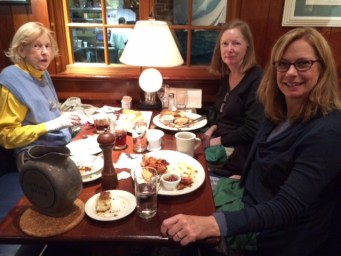
My sister and I sit across from our mom and keep the conversation going.

This is a deeper dive into the sixth item from my list of things to never say to a person diagnosed with dementia. This one is a bruiser–and I watched it happen so many times by people that are trained to care with individuals who have dementia, that it shocked me every time.

Most often, issues come up in a medical setting. Early on, when we would visit a doctor, I would bring a note explaining my mom or dad’s diagnosis because MOST DOCTORS DON’T READ THE MEDICAL RECORDS. I would confirm with the person doing the intake that they got the note so I never needed to say in front of my parents that they had been diagnosed with “multi-infarct dementia” or “Alzheimer’s”. Before I adopted this tactic, my parents would respond with disbelief and anger which created a whole cycle of inquisition by my parent who never recognized or absorbed their diagnosis.

Unfortunately, when the doctor arrived, they would turn to ask me questions as if my parent wasn’t there. I would immediately turn to my mom or dad to see if they wanted to answer. They would usually say they had nothing to share and I would then offer up a response. I know that the doctor’s don’t have much time to be with the patient, but this is something that for humanity sake, really shouldn’t be rushed.

The worst was when it was done by the family. I understood they don’t know what they don’t know, but you could watch the family visit go sideways almost without fail when it happened.While they might not be able to navigate a conversation about even the weather, at our core, we recognize being slighted. It must be one of the most basic human qualities that helps keep us alive.

When we visited with our parents, my siblings (or my kids) and I would always include them in the conversation, even thought we might be carrying on the entire conversation.

There were several times when I would want to talk to my mom’s personal care assistant about something and I never did it in front of my mom. We would meet outside of her room, or take a quick walk together.

As the person with dementia is losing the ability to remember or even navigate their day, the thing that needs to remain is their sense of worth and that element of them survives all the way to the end. Witnessed. 

5. Don’t think they can’t communicate just because they don’t speak.

fingerpokeThis is the fifth item from my list of things to never say to a person diagnosed with dementia.

The story that immediately pops to mind happened a little over a year ago. I hadn’t met very many individuals with dementia who had stopped speaking until my mom moved into a memory care community. While I had experienced periods with my parents when one of them would be quiet on a visit and they seemed unsure of what to say, they never stopped speaking until the last few days of their lives. So I had more direct experience with my last post on don’t assume they can’t understand you because they are silent.

I still smile when I remember my visits when Gwen would join us. She would only join us when we were sitting off to ourselves, and usually focused on a craft of some sort. She always had a relaxed way about her, but always seem to want to hide the things we were working with. She would subtly remove a paint brush, or a feather, and seemed to wait to see if anyone noticed. I was glad we used non-toxic paint when she decided to drink my cup of paint water on the table before I could stop her.She looked right in my eyes and grinned before I could get out a word. She never did want to join us in our activity, but every time she joined us, I felt like a little bit of my dad had arrived. He was always the jokester.

One day, when another resident came over to join us, Gwen stuck out her finger so that when the other resident sat down, she would get a poke to the rear. While the resident didn’t notice, Gwen burst out into giggles and I quickly joined her when I found the resident wasn’t harmed or offended (thankfully).

I never really thought about it at the time, but looking back realize how much I had learned about spending time with someone who has dementia. I was ready to accept and visit the person that was showing up to spend time with me that day. Although, I never had a conversation with Gwen, we sure did have a few laughs together. Enjoyed. 


4. Don’t assume they can’t understand you because they are silent.

silenceThis is the fourth of my list of things to never say to a person diagnosed with dementia.

Early on, before we had a diagnosis but recognized something was wrong, I would try to over-explain things. This would only make my mom more talkative as she tried to ask questions but usually the conversation would get jumbled up and veer off in an unusual direction.

My dad on the other hand got silent. Whether it was because he didn’t want to talk, wasn’t sure what to say, or had no interest, I will never know. What I did find was that when my mom would start questioning him, he would just go silent. We initially thought our dad was depressed, and most likely he was, but he was also in the early stages of Alzheimer’s when we first noticed his silence.

Later, my dad got into the habit of saying “It’s a nothing-burger” when I raised something he didn’t want to deal with and to my mom would just reply “I don’t know” to defuse her rapidly escalating anxiety.

What I would realize after a few months of pure frustration on my part was that my dad did understand, did know the answer, but just didn’t want to discuss the matter.

I carried this knowledge with me through my mom’s move into a memory care community. There were quite a few silent residents who would respond with a smile at a simple “Hello” or would immediately come join you when invited to sit outside on a park bench. Even through my mom could talk, she started to talk less. It felt like she was feeling less sure of the words coming out of her mouth. Some days, she would be up for a lively conversation, and others, she would just wait until I shared another story.

Some much of what you learn is to see and respond to the person in front of you today. What my mom liked last year, or even yesterday, may not be something she cares for today. I was never one to find silence uncomfortable, so sitting outside with mom and just enjoying our surroundings became one of my treasured activities. Some days, I can still imagine she is right by my side when I close my eyes. Treasured.


3. Don’t correct or challenge trivial things.

trivialThis is the third item from my list of things to never say to a person diagnosed with dementia. It took some time for me to learn this and I feel like its a partner to tip #2 to not say “remember” — they go together.

I recognize this “don’t” is sadly one of my righteous habits. I know that it has softened over time but growing up in a smarty-pants family where debate was encouraged, we got in the habit of pulling apart arguments plank by plank.

When mom and dad were driving, forgetting to pay bills, and calling me over-and-over to ask the same questions like “what day is it?”, I thought pointing these things out as a failing would help them finally sell their town home and move into the retirement community full time. Oddly enough, they recognized that their spouse was doing poorly, but never recognize a weakness in their own abilities.

What my behavior did was to create distrust with my parents. Generally, my mom would become argumentative, and my dad would shut down.

I realized that I had to change because my parents were unable to recognize what was happening and therefore unwilling to make any changes to their lives.

What I didn’t know then, and still would not have accepted, was that I would have to wait for something to happen to force a change. When dad broke his hip, required surgery, spent several days in the hospital, and weeks in rehab, I was able to learn a lot more about how much help my mom really needed on a day-to-day basis. It also gave me time to collect more information on their finances and their medical history so in the future I could be a better advocate.

I started from the place I knew and within that familiar dialogue I had with my parents as their adult child. However, with their dementia, logic was not logical to them, they were recreating their memory because they didn’t remember. My habit of debating matters, especially when it came to the little things, only made the road more difficult for all of us. Experienced.

2. Don’t say “Remember when … “

rememberHave you ever had a friend say “Remember when …” and you have NO idea or recollection of what they just recalled? We can usually giggle about it with our friends. I have to say the worst are the times when my husband will say “remember when we … ” and my only response is “ummm, I think you did that with one of your girlfriends” and there is probably a little edge of jealously in my response.  After close to 20 years of marriage and several years dating before that, those stories don’t happen as much anymore, thankfully.

However, in some ways when we are talking to someone with dementia, the use of “remember when …” and “remember” is perceived differently since more often than not the person you are asking cannot remember. When someone asks me if I “remember” and I don’t, a little panic button goes off in my brain. How might that feel if you no longer have the ability to retrieve information and this happens to you all day long? When I started to consider that, I could easily understand why some discussions with mom ended up with her feeling anxious.

When I first heard the advice to avoid the use of “remember”, I realized I was using it more often to correct my parents or point out poor decision (see the list of 20 things to NOT say to someone with dementia). I was understanding they could no longer remember, but not really practiced at how to spend time with them. At first, I was trying to get them to recognize that they could not remember, which they never did and is very common. For more insight into this, read the blog on anosognosia.

Some recurring instances included:

  • After we would order dinner at a restaurant and the waiter took the menus, my dad would complain about the lack of service — I changed what I used to say which was “Remember dad, we already ordered”, to “Oh, I heard that chicken dish you ordered is very good, and I can’t wait to get the fried tomato appetizer.”
  • After my mom finished off  a box of peanut brittle and wanted to open up another box for dessert, while I used to say “You already ate half of box,” I would instead get up telling her that I was going to see if there was more and return with a cup of tea and a new subject.

In many ways, I was using “remember” to point out bad behavior or convince my parents that their decision was poor and to illustrate why they needed to let me help. It was really having the opposite effect. When I learned how to change my responses, I found my visits with my parents went much better.

I started to show up to visits with pictures, so while I shared a story and used someone’s name, I would point to the person in the picture. I did it to help enrich the story.

Recently, I read a news article where a caregiver would take pictures on her smart phone to show her mom that she had already enjoyed ice cream. With my mom, I know that would have made her unhappy. She would recognize that she didn’t remember it and suddenly, I became the buzz kill. What works with one person with dementia, doesn’t work with everyone. No matter how you choose to visit and spend time with them, think less about what not to say, and maybe think more about how what you say makes them feel. To someone who is lost their ability to “remember”, it might not be a good term to have in your vocabulary. Reminded.


1. Don’t tell someone diagnosed with dementia they are wrong.

doingitwrongNo one likes to be wrong. Before my mom was diagnosed with dementia, but after she had a small stroke that she never remembered, we began to get into arguments. My parents and I had a close relationship and saw each other 2 – 3 times a week. My mom and I didn’t normally get into disagreements once I moved out from under their roof.

Even before mom’s stroke that left no physical reminders and that the neurologist judged to be quite minor, we noticed some changes in her behavior and recall. It turns out that mom had an earlier stroke that apparently went un-diagnosed as much as 2 decades prior to the stroke we knew about. It’s not like didn’t see a doctor– every year she and my dad both had  comprehensive physicals. .

Dinner dates were getting missed, family history was changing, and initially I would challenge mom as I had in the past. I showed up for dinner on Tuesday, she said we were supposed to meet Thursday … our relationship degraded and I felt like I was 16 and re-enacting my teen-age years (yeah, I was right then too : >.) Some of our disagreements ended with her threatening to “pop me in the mouth.” My brother shared his experience with the same behaviors in a blog post from April 2012.

What we didn’t know then was that getting into these arguments usually made mom more combative. Who likes to be told they are wrong?  This was BEFORE our parents would consider changing their lifestyle. We were afraid for their safety and well-being. However, starting these fights only made my parents fight harder to keep their independence.

You won’t win the argument, so why fuel it? Reflected.

20 Things to NOT Say to a Person with Dementia

20-things-not-to-say-to-aperson-with-dementia-updated-6june2014.jpgThis list comes from Kate Swaffer who after being diagnosed offers a fresh perspective on how to live beyond dementia rather than only die from it, and how family, friends and dementia care professionals can more positively support people post diagnosis to do this. She has lovingly challenged, advised, and counseled me quite a few times on my journey. We even launched a Q&A blog where we peppered each other with questions.

As a follow-up to my go-to strategies for family visits, I plucked a few key tips to consider and am listing my top ten:

  1. Don’t tell the person they are wrong.
  2. Don’t say “Remember when … “
  3. Don’t correct or challenge trivial things.
  4. Don’t assume they can’t understand you because they are silent.
  5. Don’t think they can’t communicate just because we can’t speak.
  6. Don’t talk about them to someone else in front of them.
  7. Don’t remind them of a death of a loved one or pet.
  8. Don’t blame them for the changes in their behavior.
  9. Don’t assume they can’t answer for themselves.
  10. Don’t assume because they can’t tell you, that your words or actions don’t hurt their feelings.

It is easy to read the list, but not as easy to make these part of your actions when you are visiting. I am going to share my individual experiences with each of these over the next month. It time for me to learn and I hope my mistakes will help you learn faster than I did!

Be mindful of the words you use, and forgive yourself when you make a mistake — just build on what you are learning. Recognize that the person diagnosed with dementia still has the same craving for meaning and purpose that is the core of every human.

The changes in behavior are not hidden personality traits. As the brain is changing, so is the person living with dementia. When you have met one person with dementia, you have met one person.

Thank you to Kate who continues to be a beacon of hope living with dementia working to provide us with inspiration, love and truth. Admired.