Finding ways to work through the stress of caregiving

tennisI wanted to improve my tennis game so my husband and I joined the local gym that offered tennis. It took me a while to get into lessons, flights and play with others who would help me be able to improve my game.

Several women welcomed me and invited me to join their weekly groups and even join into their lessons. Tennis has been an incredible way for me to find new friends as well as work off the stress of caring for my parents.

Most of my tennis friends know what I’m dealing with. My parents have come to watch matches. When my father died, I actually volunteered to step in and play if someone needed a sub as soon as the day after his death. I find the rules that require you to turn off your phone and dedicate uninterrupted time therapeutic. I can shut off my brain to life outside of the court lines.

A friend shared an article that was recently posted in The New York Times called “Walking the Talk” and I love the idea. After the winter we have faced, the story is compelling and makes me wonder if there are local groups like this to help move through the stress of caregiving.

What are you doing to work through the stress of your caregiving experience? Asked. 


Medication Roulette and Dementia

rouletteMy Mom is sliding into the deeper grasp of dementia. It is surprising to many people (and often to me) how one moment she can be so lucid, and the next, totally disjointed. She continues to try and join in the activities of the Independent Living community she was a member of for over a decade. Now, she’s confrontational and many of the residents are complaining. It’s sad that the community can’t deal with her, but even those that are well-trained are having a hard time re-directing her when she gets aggressive.

In my Mom’s community, Assisted Living is a hallway away from Independent Living. Now that my Mom’s full-time companion, my Dad, has passed, she is alone and really having a hard time finding a footing. The dementia is making it impossible. She’s very lonely, but on top of her grief, she is unable to make new friends and her friends are finding it hard to engage her now too.

Mom founded many of the bridge games and loves to play, but she can’t remember, nor does she recognize that she is no longer running the games. She’s short-tempered and rude with most of the other bridge players — a concept that would horrify the woman who raised me. However, this is the woman most of the bridge players see and don’t know the caring woman that formerly inhabited my mother’s being.

The doctor changed her medication and added the Exelon Patch (to help cognition) and Risperdal (to minimize anxiety and paranoia). They also asked us to hire personal assistants from 1 to 9 PM daily. The first two weeks went well and then things fell apart. The doctor is increasing her dosage and we have replaced the assistant that worked on the days I noticed my Mom having the most trouble. Risperdal is an off-label prescription and when we first got the recommendations, we did our research and gulped as read the side-effects. We have to try something new, because now, she is not doing well.

The current options outside of increasing her medication:

  • Move her to the section of Assisted Living and put on a Wander Guard. This prevents the doors from opening and the elevator from working. I can just visualize my Mom banging on the doors and confronting anyone that tries to use the doors if they don’t work. Both the AL staff and I don’t think this is the right solution.
  • Check her into a psychiatric facility so they can treat and manage her dosage and find the right mix. This could be a 2 to 3 week visit. The change is living arrangements alone will confuse and frighten my Mom and my biggest fear is that they will medicate her into a submissive state and she will return to just be admitted into the lock-down memory community.
  • Find a new facility that is dedicated to memory care and move her from the community she choose. This seems like the most logical next step for us to pursue.

Please let me know what your experience and suggestions maybe as we try to navigate this new transition in my Mom’s care. Pleaded.

Prior Related Topics include:

The Benefit of a Continuing Care Retirement Community

Your Parents Agreement with the Retirement Community is being Terminated

We are Ready to Move into the Retirement Community


The Two Stinky Options for Dementia Care Givers

marie marley
Marie Marley

I am thankful that my parents choose their retirement community. It alleviates most of the guilt I feel, however, it doesn’t mean you aren’t involved or acting as a care giver. Helping my parents has been and continues to be a part-time job. The community works with me and my siblings — we are actively involved as advocates and care givers — and have been for more than two years.

Right now my siblings and I are struggling to know if my Mom is in the right place. With dementia, the transitions are the trickiest and I’m not sure one community will always be the right place for everyone. The set-up of the Assisted Living community is proving to be very challenging now. We are possibly going to have to find her a new place if the place she selected confirms that they are just unable to help my Mom any longer.

I enjoyed reading this article in Huffington Post by Marie Marley who speaks to The Pros and Cons of Placing Your Loved One in a Facility.

It’s a good read, and a good reminder that both choices stink. Conflicted.

When They Believe, So Do You: Dementia and the Truth

locked  doorMy Mom is now sundowning and paranoid. The doctor has recommended new medications and the staff has asked that we hire additional support who can help redirect her from 1 to 9 PM daily. It seems odd that she would need additional support given she is in Assisted Living, but she is a very mobile and moving into more behavior that is resulting in concerns for her dignity when she wanders into the Independent Living community where she lived for more than a decade. She is getting very confrontational and Independent Living isn’t staffed to help her.

The doctor has adjusted her medication and we just hired a personal assistant who has been told to lurk in the hallways and be as invisible as possible. As I’m leaving a late night tennis match, my Mom calls to tell me that they are trying to move her out of her apartment.  She tells me she will “barricade the door” until I arrive in the morning. I tell her I’m coming over now. She is relieved.

When I arrive, I stop by the nursing station and they tell me they saw my Mom walking to the Independent Living dining hall, but had nothing to report. I ask if they had seen anything to give my Mom the impression she was being moved from her apartment. As soon as I ask, I realize how silly my question sounds. They smile and tell me “No.” My Mom was very convincing on the phone — I know she believes what she tells me which is heartbreaking. I imagine how frightened and alone she must feel.

When I get to my Mom’s apartment, she is wound up and happy to see me, but doesn’t mention someone trying to move her out and there is no evidence to support what she told me when we spoke 25 minutes ago. She doesn’t even remember calling me. However, tonight she is frantically moving around the apartment. I suggest we find her pajama’s so she can get ready for bed and I can go home. We spend almost 40 minutes looking for her pajama top. It’s a two-room apartment, but my Mom continually embarks on a different task and I try to settle and redirect her which makes the search so lengthy.

I step out and request something to help my Mom settle down. They give me a dose of Ativan and I set the pill container on the kitchen counter. When my Mom sees the pill, she quickly picks it up and takes it — I didn’t need to prompt her. We never do find her PJ top and after 2 hours, I realize my Mom is not going to go to bed or change into her pajamas as long as I’m “visiting.” When she starts to yawn and slow down after the Ativan starts to calm her, I kiss her good-night.

I recognized years ago that my Mom believed what she was telling me. Usually it was that she was paying the bills or ate breakfast — things I knew not to be true because I was doing them or had been with her all morning and she refused breakfast. It’s harder to know the truth when you aren’t with her, my Mom can still be very convincing.

The hardest part is that I know she believes what she tells me. My Mom is all alone and I wonder how to help her be more at peace. Challenged.

Dementia: Episodes of Unbecoming Behavior

snakebiteWithin days of the Assisted Living facility calling me in to work through how we might better help my Mom, she was involved in an incident where another resident ended up on the floor. We received few details, but I have witnessed, and the staff has reported that my Mom is getting more combative. She has periods where she is verbally abusive and physically threatening. She’s now about 5’7″ and 110 pounds, but is able to command a larger presence and scares other residents.

My general rule has been to tell my Mom once what is happening and what has been reported to me. The discussion is always difficult and she is always frustrated to hear that I have been told something about her when she was not present.  I totally understand that emotion.

However, even when she was present, she doesn’t remember. My Mom will argue each item and demands written documentation. When it is provided, she rips it up. From that point forward, I work to implement the changes and redirect conversations or frame them with information that my Mom will accept.

Within the past year, I have met several residents who will share how my Mom was one of the first residents that welcomed them into the community. However the dementia has changed her and now, she’s the woman everyone avoids.

The head nurse calls to let me know the doctor is going to meet with her and look into some new medications. The Ativan (by itself) can’t help anymore.

Just when I think I have absorbed the changes in my Mom, something new emerges. Rattled.  

Voices of the Sandwich Generation Dementia has Fueled

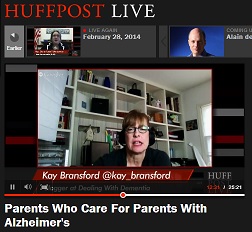
huffpostI was interviewed by Nancy Redd with Huffington Post who did a story on Parents Who Care For Parents With Alzheimer’s. She interviewed three of us, all at different stages with parents who have dementia and all with children.

You can watch the video interview and hear from:

  • Kathy Ritchie @MyDementedMom (Phoenix, AZ) Blogger at My Demented Mom; Writer. Kathy has a toddler.
  • Kay Bransford @kay_bransford (McLean, VA) Blogger at Dealing With Dementia; Chief Curator at MemoryBanc. I have an 11 and 16-year-old.
  • Susan Poulos (Greensboro, NC) Caring for Mother with Alzheimer’s; Freelance Writer. Susan’s boys are now considered adults.

It was interesting to hear the stories and I hope you will watch. Shared. 

Where are you? stings more now

spiralstairA year a half ago, I posted an article entitled “Where are you?” — and I’m still feeling the same guilt — only magnified. At least the last time I went through this stage and wrote about it (it is a recurring issue) my Dad was there with my Mom. Now I know my Mom is by herself. I also know based on my visits and from the staff reports that she is not doing very well in the community.

I get a call two hours after I visited asking me where I am and when I will be arriving and there is something frenetic in her tone.

She will go through these cycles. I imagine her decline is much like a child’s development, but in reverse. When my son was 4, someone shared that kids develop in an upward spiral — two steps forward, one step back. In my Mom’s case, she goes two steps backward, and one step forward.

When she asks me when I’m coming out — I ask her if there is something she needs instead of telling her I was just there and we went to the grocery store. She asks if I can hold on, and I wait as she roots through the kitchen and comes back. By the time she returns she picks up the phone and out comes gibberish. I ask her if she has Coke.”Wait,” she asks. She returns and this time tells me she has Coke. I transition the conversation to tell her I’m on my way to pick up my daughter and what we will be doing this afternoon. 

I fight my logical mind and remind myself of the a poem someone shared with me a few months ago that I renamed the Dementia Request. Each time I gain a little more understanding. Absorbed.  

Dementia Request

Do not ask me to remember, don’t try to make me understand. Let me rest and know you’re with me, kiss my cheek and hold my hand.

I’m confused beyond your concept, I’m sad and sick and lost. All I know is that I need you, to be with me at all cost.

Do not lose your patience with me, do not scold or curse or cry, I can’t help the way I’m acting, I can’t be different through I try.

Just remember that I need you, that the best of me is gone. Please don’t fail to stand beside me, love me ’til my life is gone.

A Belated Love Note to Professional Care Givers

heartsAs I was cleaning out some old boxes of papers, I found a booklet on “Managing Alzheimer’s” that was given to my parent’s in 2010. We didn’t know of my father’s diagnosis until a neurologist and psychologist both reported their findings to us in 2012.

In 2010, my siblings and I all noticed a change in my Dad’s normal jovial behavior. He was solemn and talked very little. My brother and sister took him to his primary care provider who referred a local visiting medical service. A nurse visited him in his home every week for six weeks. She called me to say he and my Mom seemed to be doing alright, but told me she left some papers that might help.  I remember my Mom commenting on her visits – my parents had no idea why she was visiting them in their home. I’m sure I ended up with the booklet when my Mom was complaining about her last visit.

My Dad’s primary care doctor never alluded to any suspicion of Alzheimer’s — and I visited her with him at least twice after this referral. Looking back, I realize how many signs we had been given. It wouldn’t have changed the journey because my parent’s never acknowledged any issues and we worked to manage through while maintaining their dignity and independence.

Yesterday, as I was going through the mail to pay bills, I found a card from the Alzheimer’s Association that said my Dad had been donating since 2011. My parents habit was to review the charities each January and make one annual donation. In January, 2011, they added the Alzheimer’s Association to their list. My Dad never discussed any medical issues with any of us kids. We inserted ourselves into his care.  The only time he pushed back was when the psychologist was going to deliver the results of his neurological testing. He knew he did poorly, he told me so.

He only once mentioned the word Alzheimer’s to me, it was in the final month of his life. As we were in the waiting room to see the first oral surgeon about the lesion on his tongue — he pointed to an advertisement in the magazine and asked me if I knew anyone with Alzheimer’s.

I reflect back on the woman who visited my parents and who left these papers. She already knew and helped provide us with information using kid-gloves. It was all that would have been accepted. Professional Care Givers are a rare breed with skills that continue to elude me. My hope is that we all remember to thank them as often as we can. Reflected & Appreciated. 

Yikes! One in Three Americans is a Caregiver.

crowdAt almost every visit, my Mom will ask “Who would help me if you weren’t here?” I tell her friends would fill in or she could hire someone, but she always bats away these responses. My mom is currently in an Assisted Living facility. For three years I have been very involved in the care and support of my parents. They were 78 and 79 years old when I turned into a caregiver.

An AARP report from 2010 stated that one-third of U.S. adult population plays a caregiver role in households across America. That totals 65.7 million caregivers. A previous report I found put this number as 44 million — either way — it’s a large number of people. We all have unique roles and challenges as caregivers.

At almost every adult gathering, you will find a discussion about this topic and many of the caregivers are overwhelmed, frustrated and often hog-tied because they lack access to the information they need to better support the person they are helping.  

I feel like I was lucky. Because my parents had dementia, I had time to work with them to collect and organize much of their household information. My parents had completed their estate plans, and I held a Durable Power of Attorney. When that didn’t work or we found that it could take weeks and even months to navigate the approval process. We ended up setting up online access to most of their accounts to allow me to easier help my parents. Shhhh, don’t tell — it’s against most online user agreements.

For those of you dealing with a loved one with dementia, please know that my mother was very resistant to turning over these reigns. To this day she doesn’t recognize her limits and I set up a small checking account so that she could still keep a checkbook in her wallet and write checks if she so desires. My father helped me navigate most of their accounts. I hope that you are able to at least get access to the information you need. Once you have gone through the process of trying to be a caregiver and running into roadblocks, you will start looking at your own life and affairs. If someone needed to step in and help you, could they?

This topic seems to be such a cloaked conversation. I do see media outlets covering the topic more as many in the media are dealing with issues in their own families and are trying to bring light to this topic. I’m doing my job to shed light on this subject and offer simple solutions with MemoryBanc. Powered. 

A Beautiful Farewell

walkingcaissonThe funeral went off beautifully. There were lots of possible last-minute issues but the icy roads, rain and cool temperatures failed to impede us. Wonderfully, the rain stopped so we could walk behind my Dad’s caisson to his gravesite.

My Dad requested a “life celebration” and I worked to imagine I was witnessing one of the many military ceremonies held in his honor that I attended over my Dad’s career — which helped me be proud instead of sad. The picture I included was taken by my nephew as we walked to the burial site.

Telling my Mom that we would have half the burial service inside the chapel if it was cold outside was acceptable to her. My brother brought her to the service and we worked to keep things simple and calm. We were expecting more than 100 guests and had asked that the medical team at Assisted Living provide her with something that would help her experience the day but minimize her anxiety. Unfortunately, she knew there was an extra pill in her cup, and refused to take it.

As we are sitting in the pew and she takes in the flowers and photograph of my Dad, she turns to me and says “I can’t understand why I can’t stop crying. I don’t want to cry in front of all these people.” My brother had the pill she refused to take in his pocket. I suggested that she take it because it would help her enjoy the day and minimize the tears. She told me to go get that pill. She was able to take it before the ceremony started and immediately seemed to gather her strength.

My Mom did brilliantly. She was able to speak to most of the guests and managed through the entire reception. We had moments when she would ask where Dad was, but those that attended and surrounded us only responded with loving smiles on their faces. Celebrated. 

Q: What’s the Difference Between Obamacare and Doggy Day Care?

puppydogeyesA: Rabid Advocates — okay, poor choice of words in this case, how about “dedicated advocates?”  As a family caregiver, we know how vital it is to be involved to coordinate and have a holistic knowledge of an individuals needs and the new system, as I understand it, misses the mark.

I attended an event and heard Howard Gleckman who wrote “Caring for our Parents”  and who is an accomplished journalist, researcher and “family caregiver.”

I’m not in the senior health care industry, but like to hear what’s going on since we have been so directly impacted by the needs of my parents. Mr. Gleckman shared how one of the new trends emerging is a coordination of medical care with long-term care which represents a merger of services from Medicare and Medicaid. There are more than 7 million Americans who are being served by both today — but forecasts show this number rapidly growing as the boomers age into the program and spend down their retirement and savings and qualify for these services. Most likely, the model will grow and be offered to more Americans and could be the next generation of long-term care options.

In general, under the new models the providers will be rewarded based on “outcomes” not “delivered care”  — I would say that is a good thing. However, the ways to measure this seemed purely clinical — number of falls, number of hospitalizations, number of deaths etc. Changing the way to measure and pay doesn’t fill the gaps in our current models of medical care. Where is the quality of life component factored into the model?  Cutting compensation if there are too many deaths seems like a bad idea — even on paper.

Most doctors rely on the patient to detail medical history and advocate for themselves. My parent’s had no short-term memory. My Dad didn’t know which pills he took or why, that he had broken his hip and my Mom would never share that she had a stroke. I was frustrated when those doing the initial intake interviews would look to my parents to answer these questions — not their electronic medical records that were a keytouch away. I created a list of Do’s and Don’ts to better manage the appointments with my parents because having the doctor ask me everything was frustrating for my parents and they would disagree with some of the facts I reported.

The move to meld the services and push down costs does not incorporate the quality of life — especially when it comes to the aging population.

Obamacare changed the system, but at this time, doesn’t really fix it.

As I walk toward my father’s funeral, I don’t waiver on my belief that he had a swift and loving end to his life. However, I spent several months pushing to understand why my Dad was slurring. I reported it monthly to the health care workers while he was in Assisted Living. I eventually took him for a physical when I was underwhelmed by the progress on finding the root of his changed speech. Part of the problem is that most doctors rely on the patients ability to recap their medical history and concerns. Someone with dementia is unable to manage this.

I didn’t find a solution until I requested an assessment from the staff Speech Pathologist who finally raised the red flag on my Dad’s health.

I struggle with the fact that I didn’t manage as a better health care advocate. By the time my Dad’s cancer was detected, it was really too late to treat. We recognized that putting someone with dementia through cancer treatments would not ultimately improve the quality of his life. What an awful choice that we his children were faced with.

My brother and I who walked this journey with our father were hit hardest by the grief. We rode the roller coaster of hope when we thought we could buy my Dad a few more months of life. In one week, our journey flipped from remission to hospice.

We thought long and hard about the choices we were making and based on the beliefs our father had shared. We vetted our choices with all four children. We did not make our decisions lightly, and some of us still carry the grief and guilt scars that resulted from our choices.

Ultimately, I am thankful for the time I had with my father and treasure the final days we spent together — especially because I had no idea they would be our last days and memories together.

It doesn’t exist in the current model but given the amount of caregivers and family members who have witnessed the current aging options, the lack of an advocate in the new models emerging feels sterile to me. The embedded HOPE is that family members will be engaged by the assigned ‘case managers’ which has proven to result in better health outcomes.

Any misstatements of the emerging models falls on me — not Mr. Gleckman — his presentation was fantastic and very educational. However, after hearing the facts he presented, I felt like I was listening to a new system of care to that would be just as likely to be presented to care for dogs. Perplexed.

This is a HUGE topic and I skim over some key issues. I’d love to hear from you. Please share comments or your blog posts that tackle some of these issues.