Three Go-to Tactics for Dementia Caregivers

lionessThe holidays are hard for us all. It’s our first without our Dad. My siblings came to visit and I know my Mom enjoyed having lunch and dinner visitors.

I revisited my blog from last year talking about Christmas — the visits with my Mom were more difficult since she was almost always agitated and would get stuck on a specific thought and action.

Since she moved into Assisted Living, the visits are much easier. I have broken my visits down into two types: I’m visiting the lion or the lamb.

When I show up and I’m facing the lioness, three things that have served me well include:

  • Smile and patiently answer questions … until you can politely redirect the conversation
  • Don’t say “Remember” The lack of short-term memory is usually the first symptom to take root and pointing it out only creates bad-feelings and animosity.
  • Explaining only creates more confusion Layered with the lack of short-term memory, the idea that logic will prevail tripped me up initially. I will explain something once, then work to redirect the conversation.

My mother has always been a very independent woman. She raised four kids while my Dad was away at War in the 50s and 60s and was always the prime disciplinarian. While dementia can change behaviors, the need to independence and sense of purpose is still very alive and well in my Mom. Practiced. 

Please share with me if there are things you do that help you and the person you are caring for. 

A Caregiver’s Repreive

LakeVermillionSunrise
Photo Credit: Cole Bransford

My siblings are wonderful. I know from many of you that I’m lucky to have engaged siblings who will and can help. As we rolled into Christmas, my siblings came to town to visit with my Mom so I could spend time with my husband’s family who would be visiting us.

Initially, I still got a few calls from Mom when she was confused by a call and didn’t know how to reach my brother or sister, but for nearly three days, I did not get one phone call. On the third day — I started to ignore my mobile phone (it was Christmas Day) since my kids and husband were all with me and I knew my Mom was in the company of my sister.  As soon as my sister’s flight left, the calls began.

I believe my Mom calls me when she is lonely, which only reignites concern over her well-being. I’m thankful she is in an Assisted Living facility, but can’t imagine anyone being in one without a family that visits, calls or advocates for their loved one. The fact that she is already in a place prepared to support her and that it is one she choose makes my caregiver duties much lighter, but it does add a level of complication. There are things that happen that we learn of second-hand, can’t control and don’t like.

However, I recognize the toll of my constant concern as the only local family member as well as the guilt that I’m not visiting her daily are taking on me and know that I need to give myself more breaks. I can’t make up for my Mom’s lack of short-term memory by calling more, I can’t feel guilty that I don’t visit more, but I can love her and be mindful of her needs.

One of the best tools I found to manage was using Google Calendar for my family scheduling. When I started to feel overwhelmed by raising my children well, caring for my parents and work, I worked with a life coach. She helped me develop my priority system. I use that to determine what goes on my schedule and review it quarterly to ensure I’m not neglecting key elements of my life. My husband and children all use the calendar to stay in synch. It works well for us.

A change in the routine of life can be eye-opening. Helping my Mom is such a daily part of my life, I didn’t recognize until I stepped away for a few days how much mental time I spent on the topic. It was nice to have the mental break. Recognized. 

Related Articles:

Ten Ways to Deal with Caregiver Stress (AARP)

Respite Care: A Break for the Caregiver (AARP)

Thank you to my siblings — and all of those friends and caring individuals who continue to pay visits and write letters to my Mom.

What’s in that Online User Agreement You Accepted?

I-agreeMost of us click the box and don’t think twice about what’s in “Terms of Use Agreement” when we check the box to “Accept”.

The typical web user has 25 online accounts, ranging from social media to online banking (according to a 2007 study from Microsoft). Did you know that most include a clause that makes your assets non-transferable upon death and many will force account deactivation?

Even if the rights are given to you in a Will or Durable Power of Attorney (POA), using them can be difficult. As I found when I tried to act on my parents behalf when they were both alive — you may have the right by law and on paper — but that doesn’t make the vendor accept that you have the legal right. After several financial firms told me they wouldn’t accept the POA my parents completed in 2002 (if was over two or five years old which was their requirement), we ended up drafting a new one. Most lawyers will tell you they don’t go stale — but I didn’t have the time to pursue a legal battle with banks — thankfully — I found out before it was too late for my parents to sign a new POA.

I learned that having the paper with the rights isn’t as easy to use as you are lead to believe. Even if you are named the “digital executor” it won’t guarantee you have the power to bestow access to your loved ones.

You have the power to make this a simple matter. Write down your usernames and passcodes and put them in a place your loved one could find if they need to use it. One way to document this information is in a MemoryBanc Register. Experienced.

Two current news stories on this topic can be found here:

What Happens to your digital life after death? (12/2/2013) Pew Research Center

What Happens to Digital Assets when you Die? (12/2/2013) Grand Rapids Business Journal 

Seventy percent of American’s over 65 will need long-term care

70%Wow. Ignoring the facts won’t make them go away. They seem unbelievable.

The National Clearinghouse for Long-Term Care Information reported that about 70% of Americans who live to age 65 will need long-term care at some time in their lives, over 40 percent in a nursing home. Learn more by visiting their website and to learn more about how you can plan.

The same report cited the averages: Those who are 65 today will need long-term care services for three years. Women need care for longer (on average 3.7 years) than do men (on average 2.2 years). While about one-third of today’s 65-year-olds may never need long-term care services, 20 percent of them will need care for more than five years.

The most important thing you can do today (at ANY age) is set up a Durable Power-of-Attorney. There may be situations in which even your spouse needs this document. Check with a local estate attorney.

Having your estate planning and financial plan in order is important, but more important is making sure your accounts, access codes and personal papers can be easily found by those who may need to step in and help you. Until our late 80s, we are more likely to suffer a temporary incapacity than we are to die. CNNMoney reported than more than $58 billion in unclaimed money and assets is sitting with state and federal treasurers — it’s the stuff that got lost in the shuffle of a move, personal crisis as well as death.

Here is a link to the full list of papers so you can do it yourself. If you want to be prompted through the process in a workbook format, you can order a MemoryBanc Register. Use the term “Reader” for a 10% discount on your order. Alerted.

The Representative Payee Process with SSA

sscardIn May, I visited the Social Security Administration (SSA) and applied to be the “representative payee” for my parents. I was gleeful with the ease and simplicity of the process.  I met with staff, made some sworn statements, signed a paper confirming my relationship and duties as well as supplied my Durable Power of Attorney. I was told I should get all the information in the mail in 4 – 6 weeks.

When nothing arrived, I called several times but kept getting routed to the call center and no one there could assist me. While I had the contact name of the woman I met, the number she provided rolls over to the call center and I was never able to reach her after my initial visit.

In August, three months after my visit, I received a letter telling me my Dad’s check was withheld due to an address problem. The letter allowed me to follow-up with a specific contact and in trying to resolve this, I ask is they can find out what happened to my Mom’s papers. I am told they can’t speak to me because her paperwork never got processed. But I did them both on the same day and with the same woman. How can this be?

The nice man on the other end of the phone from the Social Security Administration (SSA) tells me that at this point, I need to get back into the office to clean up the issues. When I ask to schedule an appointment, which was so easy the first time, I’m told that the first available appointment is two months away. He is sympathetic and explains that the local offices have been given additional responsibilities and they are really busy these days. I hang up thinking I need to find a day to spend back at Social Security.

That afternoon someone from SSA called and wants to talk with me. She asks me a few questions and says they are going to try to clear this issue up without me having to go into the local office. I’m pleasantly surprised. Within a few weeks, I receive my Mom’s paperwork and my Dad’s account is updated.

Kudos to the SSA staff — once I got the letter and followed up to the assigned contact — he listened to me and worked to resolve this for me.

However, the process took over four months from beginning to end and I had to manage the checking account and bill payments without this money for two of those months because my Dad’s payments were frozen.

Two months later, my father passed away. and to process the transition of his military retirement pay, I need a copy of my Mom’s social security card. We have searched high and low, and there is not one to be found. Looks like I’m headed back to the Social Security office. Warned.

TIPS:

– Ask for an appointment to avoid REALLY long lines at the local office

– Show up with Social Security Numbers, a valid driver’s license ( or other accepted photo ID) and your Durable Power of Attorney

– Expect this process will take several months

– Be prepared to manage without pay if something goes wrong during the processing

– Request that they send you a Social Security card (don’t know if they will, but recommend you ask)

The Double Whammy

double whammyI find an Oral Surgeon who can address and treat the “growth or abscess” in my Dad’s mouth that is causing the garbled speech. All Oral Surgeons are not the same, some focus on extracting molars, while other’s might focus on treating sores and doing minor oral surgery. I sense I need to find one who can remove the growth or treat the abscess on my Dad’s tongue and land an appointment with a recommended specialist within one day. Phew!

When we arrive, my Dad grabs the medical forms and starts to fill them out. He asks me about the date, but whizzes through the form in his unique, very legible hand-writing. I volunteer to take the forms up to the front desk and make sure that I will get the bills and review the forms before I hand them over. I want to make sure they know my Dad has dementia, but don’t want to have to say this in front of him. I told them on the call, but this got lost between my call this morning and our appointment I’m afraid.

When they check us in, the nurse turns to my Dad to ask him a few questions and he responds “I’m just the driver.” I turn to my Dad and tell him that we are here to see how to make his tongue feel better. “Oh! Good,” he responds.

We end up sitting in the waiting room for more than an hour. My Dad is reading TIME and turns to me as he’s looking at an Alzheimer’s Association Ad and asks me “Do you know anyone personally, who has Alzheimer’s?” The neurologist believes my Dad has Alzheimer’s based on his medical and psychological tests. I found that being the “truth-teller” to help my parents see their limitations only made me a person my parent’s trusted less. I’m surprised how quickly I respond that “it’s difficult for Doctor’s to really know for sure until the autopsy” and quickly transition to a story about my Son and our adventures as he is learning to drive. I can’t believe how easy it was for me to avoid the topic and re-frame the conversation. Practice makes better (not so perfect in my case.) Whammy #1 landed.

We are called into a treatment room and wait another half-hour before seeing our doctor. By the time we finally see the doctor, he spends less than two minutes looking in my Dad’s mouth and feeling his jaw line.  His gloves are off and he tells us that my Dad has a “Squamous Cell Carcinoma” that has wrapped around my Dad’s tongue and he is going to refer us to a large oral tumor specialist. Whammy #2 delivered.

WAIT! I ask is there is anything the doctor can do to make my Dad more comfortable? He can’t really move his tongue and is now mentioning that it hurts. We get an oral numbing rinse and the referral to an ENT cancer specialist and are sent on our way with the order for a CT Scan and prescription. Whammed. 

Tips for visiting the Doctor:

  1. Call in advance and let them know that the patient has dementia.  
  2. Download and fill the forms out in advance.

The Care Giving Roles and Working with Siblings

fourkids (2)The number of tasks involved when you are a care giver will change over time. I am one of four children in my family and the only one that lives near my parents.  Being the only local child means there are some responsibilities that are going to be mine — but my siblings and I have figured out how to share the load.

My parents are in Assisted Living and able to speak for themselves on their likes and dislikes. However, I believe our involvement will only enhance the quality of care they receive. Their acute medical issues will be addressed and I know they are safe. However, I visit at least twice a week to see how my parents are managing and how they are doing.

I previously wrote about my Dad and his flirtation with a wheelchair. Neither parent mentioned it to me when I called, but did to my brother. When I called the Assisted Living unit, they said my Dad was not in a wheelchair. However, when I visited the next day, my Dad was using a wheelchair. I made sure they knew of our interest to keep our Dad on his feet. In some cases, individuals with dementia will forget how to walk, and if that happened, we knew it would mean a new level of care for my Dad, most likely, in the Skilled Nursing unit (and separate from my Mom).

I’m extremely lucky. I have three siblings that are involved and will jump on a plane when I need help, or will make phone calls and manage different aspects of helping manage my parent’s estate and needs.

However, I thought it would be helpful to write-up some of the tasks we have broken out and divvied up between us. Shared. 

Care Giving Role Duties  Name of Sibling
Physical Provide or support activities of daily living (dressing, feeding, bathing etc.) and ensure safety.
Medical Manage the medical needs, doctor visits and medications. Coordinate with various doctors and follow-up on issues and concerns. Healthcare directives, Medical Power of Attorney, Do Not Resuscitate (DNR)
Personal / Financial Manage bill payments and cash flow as well as knowledge of legal documents and locations. Will need Financial Power of Attorney, be on bank accounts.
Investment Understand and manage the investments and other financial assets.
Legal Manage legal review of documents and if different coordinate with Personal / Financial to ensure documents in place and timely.
Historian Collect, organize and archive photos, letters, family keepsakes.
Realtor Lead decisions on property and manage vendor selection and transactions.

Please let me know if I missed any or if you family found another was to manage these tasks.

Birthday’s and Dementia

82PresentsMy mother recently celebrated her 82nd birthday.  My mom has had trouble remembering her age … however, I can sympathize. I told people I was 48 for almost a year before my husband corrected me and clarified that I was only 47 at the time.

I am starting to recognize that as we approach each holiday or birthday, I’m starting to wonder if this will be the “last time” we can celebrate this moment together. I am working to enjoy the moment and not let that doom and gloom notion drive me when planning. However, I do consider how to make the best of each visit and had fun with my mom’s 82nd birthday.

Since my mom is having trouble remembering her age — and in the hope of extending the birthday tidings beyond just the day of her birthday — my kids and I created 82 presents for my mom and numbered them.

On her birthday, we delivered a basket filled with 82 gifts. We had a few special presents she opened, and told her the rest of the boxes she could open at her leisure.

We visited Micheal’s, and purchased little wedding favor boxes and filled them with chocolates which is a gift she will never grow weary. I don’t expect my mom to remember our visit, or even where the presents came from, but for a little while, she can enjoy her birthday tidings. Celebrated. 

Recognizing Dementia: Repeating Conversations

The belief that memory loss and personality changes are part of the normal aging process needs to be challenged. We may recall stern grandparents, have used the term “senior moment”, or watched as neighbors seem to get more reclusive as they age.  How might we recognize changes in our parents or friends?  I know it took my family a while to recognize the warning signs.

Recently I have been hearing “my mother repeats herself, but she doesn’t have dementia.” I usually will ask one question: “Was she always this way?”  When the answer is “no” I tell them any personality change could be an early warning sign of some form of dementia or other medical issue.

Australia, the home of Kate Swaffer,  shared a new resource that offers video’s that help explain the general disease of dementia (Alzheimer’s is just one form) and how it might be recognized in your daily life. Check out this great resource.

isitdementia


Related Stories:

Is Repeating Conversations a Sign of Dementia?

How are your parents doing?

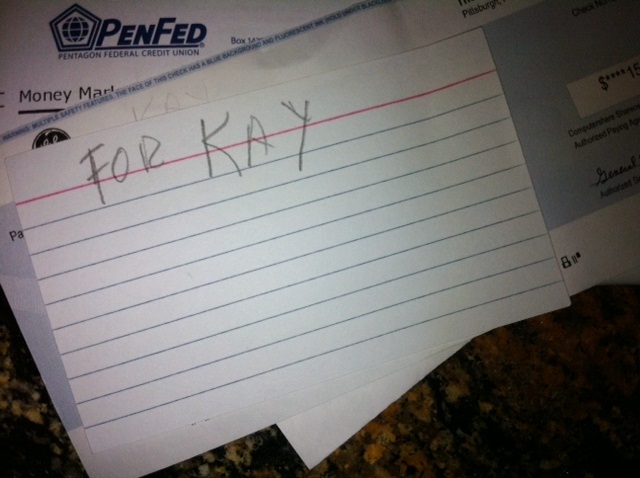
ForKayMany people ask this of me and I am pleased to share that my parents are happy. I know that my parents are not going to get better, this is a possibly a very long slow road of decline, but for now, I have a positive response when asked.

On my last visit, my mom had actually created a mail pile for me that included a bill and a check. She even put a label on the pile for me (see photo). Typically, I arrive at their apartment and as we are chatting, I will slowly wander around, pick up and sort through piles of mail, envelopes, papers and magazines.

I bring a large purse and casually drop in bills, magazine renewals and requests for donations that I find. Typically, the most important papers are in my parent’s bedroom — but I wait for an invitation to enter. On a weekly basis there is usually a reason my mom wants me to help her with something in the bedroom.

I will continue to respect their independence and tread lightly. It seems the less I push, the more they offer. Discovered.


SSA vs My Durable Power of Attorney

ssaTwo month’s ago, I shared how easy my appointment and the process was to become the “representative payee” with the Social Security Administration (SSA) for my parent’s using my durable power of attorney.

I was told I would get all the details mailed to me within 4 weeks. At 6 weeks, I started to call and cursed my belief that SSA would live up to the promise of services. The window for phone inquiries is relatively small (M, T, TH & F from 9 a.m. to 3 p.m., W 9 a.m. to 12 p.m.). On my first call during the “open” hours, the call volume was so heavy, I took the option to request a return call. A half of an hour later a woman calls from their central phone bank who is unable to help me. I am told I need to back during office hours to reach the local office. I explained that I called the number I was given during office hours. I’m told that I need to try again and know that when call volume is heavy, all calls are redirected to the central number , who in my case are unable to help me.

I tried calling more than eight times over a two-week period and was always bumped to the central phone bank. After ten weeks, my first confirmation that the process worked was my mom giving me a letter that she got from Social Security. She hands it over and asks me what it means. I tell her and she responds “Okay, Babe!” It took a lot longer than I had expected, but at least it’s finally done. Now … if only I would get the notice and details on how to login so I can update the address to make sure this year I get the tax forms. Completed. 


Related Posts:

Where Government Services Crush US Financial Services

The Promise of Services at Social Security (SSA)