Recognizing the emotional memories that last

melvinanddorisA CBS News story As man’s mind fades, heart comes to the rescue that was shared with me illustrates one of the wild cards in caring for some with dementia or Alzheimer’s. It took me a while to recognize how emotions layered in surprising memories as well as frustrating encounters along my care giving journey.

It’s wonderful story about Melvin who leaves home on foot to get flowers for his wife for Mother’s Day. The local police find him and he is adamant about bringing home flowers for his wife — but can’t even tell the police where he lives to return home. The police help him get the flowers and they return Melvin home to his wife Doris.

As the adult child caregiver, my Dad once told me I don’t understand why you are so upset. He just felt like he was exercising his right to live his life and didn’t know that their retirement community would call me when they left since they were concerned for their safety. I recognized that he would never understand, and had to adapt my own emotions to manage through the events as they happened.

With my parents, the comfort and fun we have shared have benefited me more than having to manage through parents being “parented” by their children. During a rough patch, after I got my emotions in check, I was able to spend time with my parents and find an activity we could do together that restored some of the parent-child interactions and gave them an activity they enjoyed. In one particular instance, my Mom called me twice to tell me they really had a nice time today.

The emotional memories that last may lurk in the background and I hope you will find they surprise you in a positive way along your journey. Reminded. 

Living a Life with a Purpose as We Age

Young Couple In Walking Clothes Resting On Tree In ParkI was raised believing that retirement is what you work toward—the free time to play golf, travel, enjoy a leisurely day—things earned by those who saved well and thus were rewarded with the ability to “retire.”

More than a decade ago, we started hearing news stories about seniors who went back into the work place. Typically, it was a horror story about how they lost all their money in the stock market, or they had a medical condition that wasn’t covered by insurance and drained their resources. But there are positive stories too: I see many seniors working because they want to work; they’re pursuing meaningful endeavors for the joy, meaning and purpose of it—not for the income.

As I watched my parents age, I recognized that the classic concept of total retirement isn’t going to suit my husband and me. We have talked about how we will continue to work, although it’s not so clear what shape that “work” will take in our lives.

My current path has me more focused on giving back to my community and helping other families than on the bottom line. After my experience with my parents, I feel driven to find a solution that fills the gaps left between the legal focus of estate planning, the money focus of financial planning and the personal desire to age with dignity.

Revenues will follow as I pursue my mission to help families avoid the headaches my family faced when my parents could no longer manage their own lives, and we needed to step in to assist them. Thank you, to the hundreds of clients who have supported me on my personal mission. I fully intend to reward your belief in my product by helping you implement and update the MemoryBanc Register and communicate your wishes to those people around you, who will step in to help you when you might need it most. Focused. 

This was the feature story on the May edition of the MemoryBanc Newsletter. To see the complete newsletter, click here.

The Truth Lies Between What I’m Told and What I See

eyeglassesOne of the most frustrating factors of being a family care giver to someone with dementia who lives in a community is the amount of information you just don’t have. You want so badly to ask your family member how they are doing and what’s been going on, but they don’t remember. It took me at least a full year before I stopped asking and wanting to believe my Mom’s reports on her day. It finally sunk in that my Mom probably wasn’t eating breakfast after she was moved into Assisted Living. Some days she still tries to tell me she cooked herself something on the stove. For those of you familiar with Assisted Living, they typically don’t include cooking appliances.

Just last month I shared that I drove to my Mom’s apartment at 10:30 PM one night because she had me convinced something happened and she was being moved out of her apartment. Such a rookie mistake … that happened to someone who’s been dealing with this for several years now.  I still laugh at myself over that one.

The personal assistants that have been added share small tidbits with me when I stop by and ask, but I know most of their days are spent sitting in the hallway waiting for my Mom to emerge from the apartment. I would love to have a GPS device on my Mom to see what her day looks like and where she goes. I know she’s sleeping a lot more and when there are events with music, the personal assistants say they can usually get my Mom to join them.

We are worried that one day we are going to get a notice telling us that we have to find a new home for my Mom. I was called in to discuss my mom’s “unbecoming behavior” and told if we can’t get things working better, we will need to look for a new home that can better care for my Mom given her mobility and dementia. So far we have worked with the community to make the following changes:

  1. Adjust the medication. We are told she is now getting the highest doses they can administer to a resident in Assisted Living. It can take several weeks to see if the medication helps manage my Mom’s behavior. I appreciate how the community phrases the concerns as a “dignity issue.” My Mom seems to be mellowing and I haven’t gotten any reports in over a month about any “unbecoming behavior”.
  2. Hire personal assistants. As I have shared, my Mom really doesn’t like and resists the idea that she would need help. However, we are paying for personal assistants from 1 – 9 PM daily. We had to make changes to the individuals assigned and I’m glad I’m able to stop by, meet them and speak with them. Right now it’s the closest I can get to having some insight into my Mom’s days.

Right now, things seems to be improving. However, if they start to digress, we may have to look into checking my Mom into a psychiatric hospital. While not something that happens in every case, many have had to seek this solution to find better medications manage through this stage of the disease. I do believe that if we go that route, the only option for my Mom will be to return and be moved into the secure memory unit. There is some issue with the doses of certain medications and Assisted Living,

We are doing our best. Dementia is just a cruel disease.Endured. 

Do you ever feel good when you have a parent with Dementia?

leatherA recent search brought someone to my blog: “Do you ever feel good when you have a parent with Dementia?” I hope I have conveyed in the two years I’ve shared my journey — the answer to the question is ABSOLUTELY.

The experience has seasoned me in a way that age enhances wine, cheese, and leather. My emotions are richer, my awareness deeper and my ability to give greater. I’ve always felt that I was a bit clueless when it came to social cues. As a military brat that moved a lot in my childhood, I wonder if I grew calluses on my senses and numbed my ability to pick up on social cues so I could manage through each move. I was and am still very comfortable alone. Did I cultivate this ability so I could survive puberty in 4 different schools over 3 years? My strength came from the inside, but as I’ve aged, I realize my strength was rigid.

This journey has changed the trajectory of my family, my career and my friendships. The death of my father fractured my strength. It felt like a section of my foundation was missing. While I watched as I lost my Dad in increments due to his Alzheimer’s — many of his characteristics were still in tact. I could still talk with him, he was still very kind, he cracked jokes and I could even hold his hand.

There have also been some incredibly horrible times … but they pass. I used each experience to learn.

I am still rebuilding after the loss of my Dad, but know that my strength will return and I will emerge a better, stronger, more flexible version of former self. Enhanced. 

Voices of the Sandwich Generation Dementia has Fueled

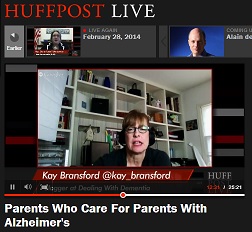
huffpostI was interviewed by Nancy Redd with Huffington Post who did a story on Parents Who Care For Parents With Alzheimer’s. She interviewed three of us, all at different stages with parents who have dementia and all with children.

You can watch the video interview and hear from:

  • Kathy Ritchie @MyDementedMom (Phoenix, AZ) Blogger at My Demented Mom; Writer. Kathy has a toddler.
  • Kay Bransford @kay_bransford (McLean, VA) Blogger at Dealing With Dementia; Chief Curator at MemoryBanc. I have an 11 and 16-year-old.
  • Susan Poulos (Greensboro, NC) Caring for Mother with Alzheimer’s; Freelance Writer. Susan’s boys are now considered adults.

It was interesting to hear the stories and I hope you will watch. Shared. 

Dad Would Have Been 82 Today

img005My father who was diagnosed with Alzheimer’s died of cancer back in September. This is our first birthday without him. It’s taken me some time to digest what I have been saying for many months — he’s in a better place now. He was uncomfortable and couldn’t eat in the final month of his life.

I still smile when I think of the number of times we would show up at an appointment and when asked by the nurse, my Dad would respond “I’m just the driver” and point to me.

My Dad was wonderful. Most of my friends were surprised to find what a kind, silly man he really was.While I miss him dearly — it was difficult to mourn our loss when he was still on this planet but no longer himself because of the Alzheimer’s. I have a lot of wonderful memories and will celebrate the day by reflecting on all the great things he taught me and all the wonderful moments we shared.

I included a picture of a moment a staff photographer captured as I was fixing one of his pins before a parade. Treasured. 

A Belated Love Note to Professional Care Givers

heartsAs I was cleaning out some old boxes of papers, I found a booklet on “Managing Alzheimer’s” that was given to my parent’s in 2010. We didn’t know of my father’s diagnosis until a neurologist and psychologist both reported their findings to us in 2012.

In 2010, my siblings and I all noticed a change in my Dad’s normal jovial behavior. He was solemn and talked very little. My brother and sister took him to his primary care provider who referred a local visiting medical service. A nurse visited him in his home every week for six weeks. She called me to say he and my Mom seemed to be doing alright, but told me she left some papers that might help.  I remember my Mom commenting on her visits – my parents had no idea why she was visiting them in their home. I’m sure I ended up with the booklet when my Mom was complaining about her last visit.

My Dad’s primary care doctor never alluded to any suspicion of Alzheimer’s — and I visited her with him at least twice after this referral. Looking back, I realize how many signs we had been given. It wouldn’t have changed the journey because my parent’s never acknowledged any issues and we worked to manage through while maintaining their dignity and independence.

Yesterday, as I was going through the mail to pay bills, I found a card from the Alzheimer’s Association that said my Dad had been donating since 2011. My parents habit was to review the charities each January and make one annual donation. In January, 2011, they added the Alzheimer’s Association to their list. My Dad never discussed any medical issues with any of us kids. We inserted ourselves into his care.  The only time he pushed back was when the psychologist was going to deliver the results of his neurological testing. He knew he did poorly, he told me so.

He only once mentioned the word Alzheimer’s to me, it was in the final month of his life. As we were in the waiting room to see the first oral surgeon about the lesion on his tongue — he pointed to an advertisement in the magazine and asked me if I knew anyone with Alzheimer’s.

I reflect back on the woman who visited my parents and who left these papers. She already knew and helped provide us with information using kid-gloves. It was all that would have been accepted. Professional Care Givers are a rare breed with skills that continue to elude me. My hope is that we all remember to thank them as often as we can. Reflected & Appreciated. 

Getting used to life without your spouse

I know my 20140205-073220.jpgMom misses my Dad. She never talks about him anymore. She used to ask why he died, but the questions stopped. Her inability to really perceive time might be a blessing since most days she thinks he died years ago instead of months.

I’m still working through my grief. i wonder how grief works when you have dementia?

Several months ago I bought her “shopping list” notepads. While my Mom enjoys the trips, if she didn’t write the grocery list herself, she challenges the validity that the item is needed.

She usually has a list now. It may take her 10 or 20 minutes to find it, but our trip goes much easier when the list is in her own handwriting.

On our last trip. she gave me her list and on the top had written “We (I) need” – I never mentioned it but watch for the moments when I can share a fun story about Dad. Remembered
.

The Value of the Open Casket

open casketI was surprised by the open casket. While I have been to other funeral’s, I have not been involved in the funeral planning — I won’t complain about being a newbie to this task at 49 years of age.

When I shared my expectation of our visit with my brother, had we been in better humor, he would have just given me a look and added “dope”. It’s funny how much of  our banter hasn’t really changed over the decades.

We both commented that we’d never choose an open casket, but a few days later, I’m happy I had the experience. My Dad looked stately and peaceful. He was in his “dress blues” which is akin to a military tuxedo. I typed up the obituary he wrote in the event of his death, and in it, he shared that “Duty, Honor, Country” are the words he felt fit his entire career as an engineer in the U.S. Army.

While my Dad had dementia and some days he was a little less put together, he still resembled his former self, just a little tuned-out.  My Dad’s appearance changed drastically over the last two months of his life. He lost nearly 50 pounds and his tongue and throat started to swell.

The last time I got to see him in his open casket, I got to revisit the father, the soldier, the man he should be remembered as. Moved. 

You need to get your Dad to an Oral Surgeon

sports benchWe have solved the matter of my Dad’s garbled speech.

My brother noticed drooling and I wondered why Dad was having trouble with his speech. Back in May, I asked their Assisted Living community to schedule a dental checkup. Two months ago, I took my Dad to get an annual physical outside the community. Given both parents have dementia and are very private people, I was worried they could not be their own health advocates and wanted to be able to raise my specific concerns with their primary care doctor directly.

Their primary care doctor just thought my Dad might be tired. He has lost 20 pounds over the past year and maybe that has played a role in his fatigue?  I pushed back and requested an appointment with an external Speech & Language Pathologist. That appointment will occur in two weeks.

In the meantime, I posted my concern, and many readers suggested we get him back to the Neurologist. I called and the first appointment I could get is in October.

Luckily, I stumbled across the Speech & Language Pathologist at my parents retirement community. When she met with my Dad last week, she raised concern that my Dad’s tongue was “frozen.” She raised the flag and the Assisted Loving community Doctor visited with my parents last Friday. At 5:30, I get a call that my Dad seems to have an abscess, lesion or growth on his tongue and I should get him to an Oral Surgeon as quickly as possible.

There was nothing we could do until after the holiday weekend.  Benched. 


The Care Giving Roles and Working with Siblings

fourkids (2)The number of tasks involved when you are a care giver will change over time. I am one of four children in my family and the only one that lives near my parents.  Being the only local child means there are some responsibilities that are going to be mine — but my siblings and I have figured out how to share the load.

My parents are in Assisted Living and able to speak for themselves on their likes and dislikes. However, I believe our involvement will only enhance the quality of care they receive. Their acute medical issues will be addressed and I know they are safe. However, I visit at least twice a week to see how my parents are managing and how they are doing.

I previously wrote about my Dad and his flirtation with a wheelchair. Neither parent mentioned it to me when I called, but did to my brother. When I called the Assisted Living unit, they said my Dad was not in a wheelchair. However, when I visited the next day, my Dad was using a wheelchair. I made sure they knew of our interest to keep our Dad on his feet. In some cases, individuals with dementia will forget how to walk, and if that happened, we knew it would mean a new level of care for my Dad, most likely, in the Skilled Nursing unit (and separate from my Mom).

I’m extremely lucky. I have three siblings that are involved and will jump on a plane when I need help, or will make phone calls and manage different aspects of helping manage my parent’s estate and needs.

However, I thought it would be helpful to write-up some of the tasks we have broken out and divvied up between us. Shared. 

Care Giving Role Duties  Name of Sibling
Physical Provide or support activities of daily living (dressing, feeding, bathing etc.) and ensure safety.
Medical Manage the medical needs, doctor visits and medications. Coordinate with various doctors and follow-up on issues and concerns. Healthcare directives, Medical Power of Attorney, Do Not Resuscitate (DNR)
Personal / Financial Manage bill payments and cash flow as well as knowledge of legal documents and locations. Will need Financial Power of Attorney, be on bank accounts.
Investment Understand and manage the investments and other financial assets.
Legal Manage legal review of documents and if different coordinate with Personal / Financial to ensure documents in place and timely.
Historian Collect, organize and archive photos, letters, family keepsakes.
Realtor Lead decisions on property and manage vendor selection and transactions.

Please let me know if I missed any or if you family found another was to manage these tasks.